

Tracking the unseen: how topological Kalman filters reveal hidden network dynamics
May 2026
Research
Read more
When a pandemic spreads through cities, you only see confirmed cases—the hospital admissions, the positive tests. But the true state of infection is vastly larger: asymptomatic carriers, pre-symptomatic people, those who recovered undetected, etc. The same hidden reality haunts every complex system. A power grid operator sees a few voltage and current readings but misses the cascading flows through thousands of lines. A neuroscientist records from dozens of neurons while billions fire in silence. A social network analyst tracks a handful of viral posts while missing the underground momentum building. We measure fragments; we need the whole.
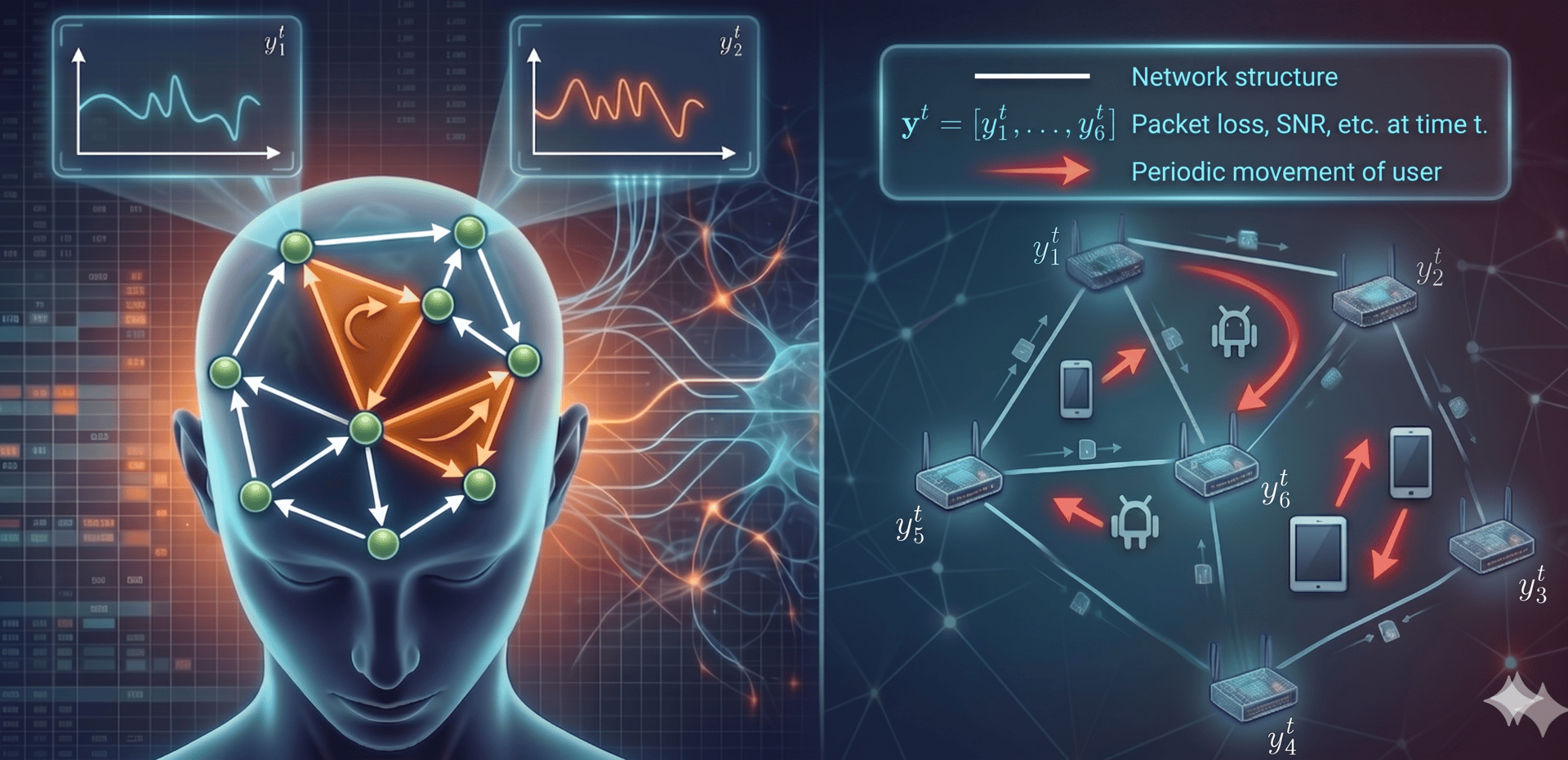
Examples of hidden topological structure and process over it. (Left) In neural pathways, the underlying anatomical edge structure is known, but the combined firing of neurons across distinct regions constitutes a hidden topological process that needs to be inferred from external brain measurements. (Right) In dense wireless networks, the mobility and physical placement of devices generate hidden electromagnetic interference patterns. These latent multi-way interactions are observed indirectly through localised metrics such as Signal-to-Noise Ratio (SNR) and packet loss at the individual devices
This is the classical problem of state estimation: inferring what's really going on inside a system from incomplete observations. Since Kalman's seminal 1960 paper, this has been a workhorse of engineering, from rocket guidance to weather forecasting. But modern systems pose challenges of high dimensionality, nonlinear observations, and unknown dependencies between states. A naive approach over-parameterizes and needs massive data. But real systems aren't random—their behavior is heavily constrained by an underlying physical or abstract topology, such as synaptic wiring, road connections, and social contacts. In this work, we use this topological information as an inductive bias to build a topology-aware state space model and perform online state estimation from partial and noisy observations. This topological inductive bias constrains the state evolution, prevents over-parameterization, and makes inference tractable even in low-data regimes.
The question we explore in this work is:
How do we track latent dynamics when the signal lives on a higher-order structure?
From graphs to cell complexes*
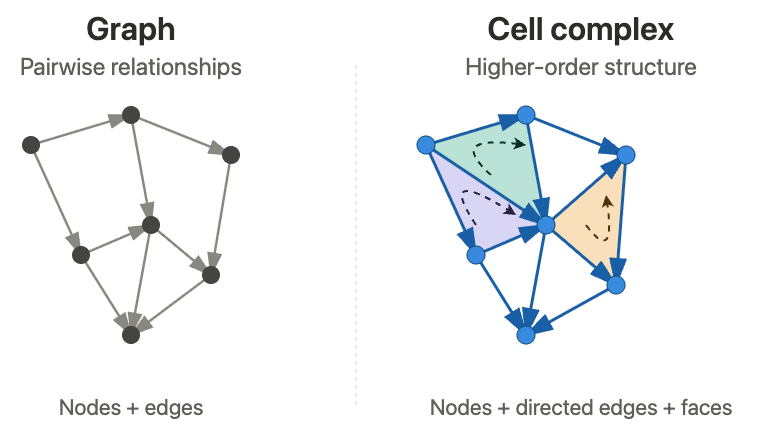
For years, graphs have been the natural language for relational data: nodes connected by edges. And graph-based Kalman filters have made impressive progress—using the graph Laplacian as an inductive bias to constrain how state estimates evolve from one time step to the next.
But graphs only describe pairwise relationships. They live entirely on nodes and the lines between them. In a brain, a graph can connect neurons, but it cannot natively represent the circuits—the feedback loops and synchronized oscillations that drive cognition and seizures. In a city, a graph can describe streets, but not the neighborhoods that create pockets of congestion and cascade into gridlock. In an epidemic, it can track contacts between people, but not the gathering spaces—the schools, offices, transit hubs—where transmission clusters and amplifies.
The signals that matter often live across all of these orders at once. A brain has voltages on neurons, synaptic currents on connections, and synchronized rhythms across neuronal clusters—and they are coupled by physics, not independent. An outbreak has cases in individuals, transmission chains along contacts, and superspreading events in places. To capture this, we need a richer mathematical object.
Cell complexes generalize graphs. They keep the nodes and edges of a graph as the 0-cells and 1-cells, but they also include 2-cells (faces, like the closed loops of a pipe network), 3-cells (volumes), and so on. Each level captures a different order of interaction.
What makes cell complexes powerful for signal processing is that they come with a beautiful algebraic toolbox. Boundary operators describe how cells of one order are bounded by cells of the order below: edges have endpoints, faces have boundary edges, and so on. From these operators we build Hodge Laplacians, which act as multi-scale diffusion operators on signals of each order, and the Dirac operator, which knits the orders together and lets perturbations propagate across them in a physically consistent way.
In short: where a graph Laplacian describes how a signal smooths between neighbouring nodes, a Hodge Laplacian describes how a signal smooths between neighbouring cells of any order (*see our earlier blog for more details).
A state-space model with shape
Armed with these operators, we build a topology-aware state-space model for streaming, partial observations.
The state equation models the latent dynamics as a stochastic partial differential equation on the cell complex. Deterministic evolution is given by a heat-like diffusion driven by the Hodge Laplacians; stochastic perturbations propagate along boundary operators via the Dirac operator. The result is that uncertainty no longer leaks arbitrarily through the network—it travels in the directions the topology permits.
The observation equation then connects the latent state to the noisy measurements we actually receive. Observations are modelled as a nonlinear function of the latent state, passed through a cell-complex convolution that aggregates information across multiple topological orders. This nonlinearity is essential: real sensors don't produce clean linear readouts of physical states.
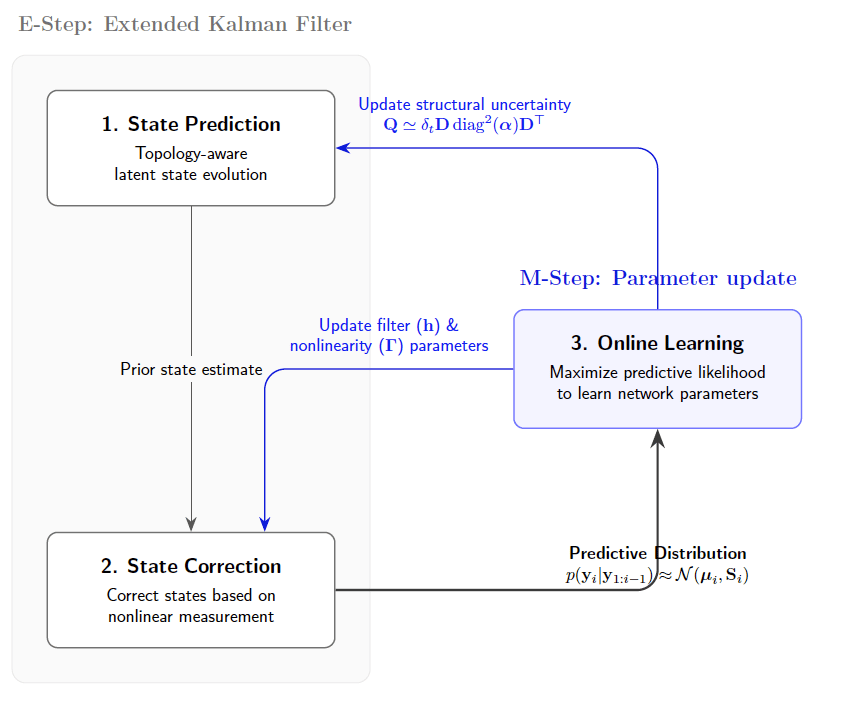
Overall learning framework
The pieces work together as follows:
- An Extended Kalman Filter (EKF) operating on the higher order structure, tracks the latent state recursively as observations stream in. Each new measurement updates the estimate, taking into account both the topological dynamics and the observation noise.
- An online Expectation–Maximization loop learns the model's unknown parameters on the fly: how much uncertainty lives at each cell, what the convolution filter looks like, and the shape of the nonlinearity.
- The nonlinearity itself is parameterized using Random Fourier Features, giving a fixed-size, lightweight approximation that can keep up with streaming data.
The whole system is trained without ever seeing the latent states directly. It learns what it cannot observe from the underlying topological structure and the partial observations. .
Discovering the hidden topology
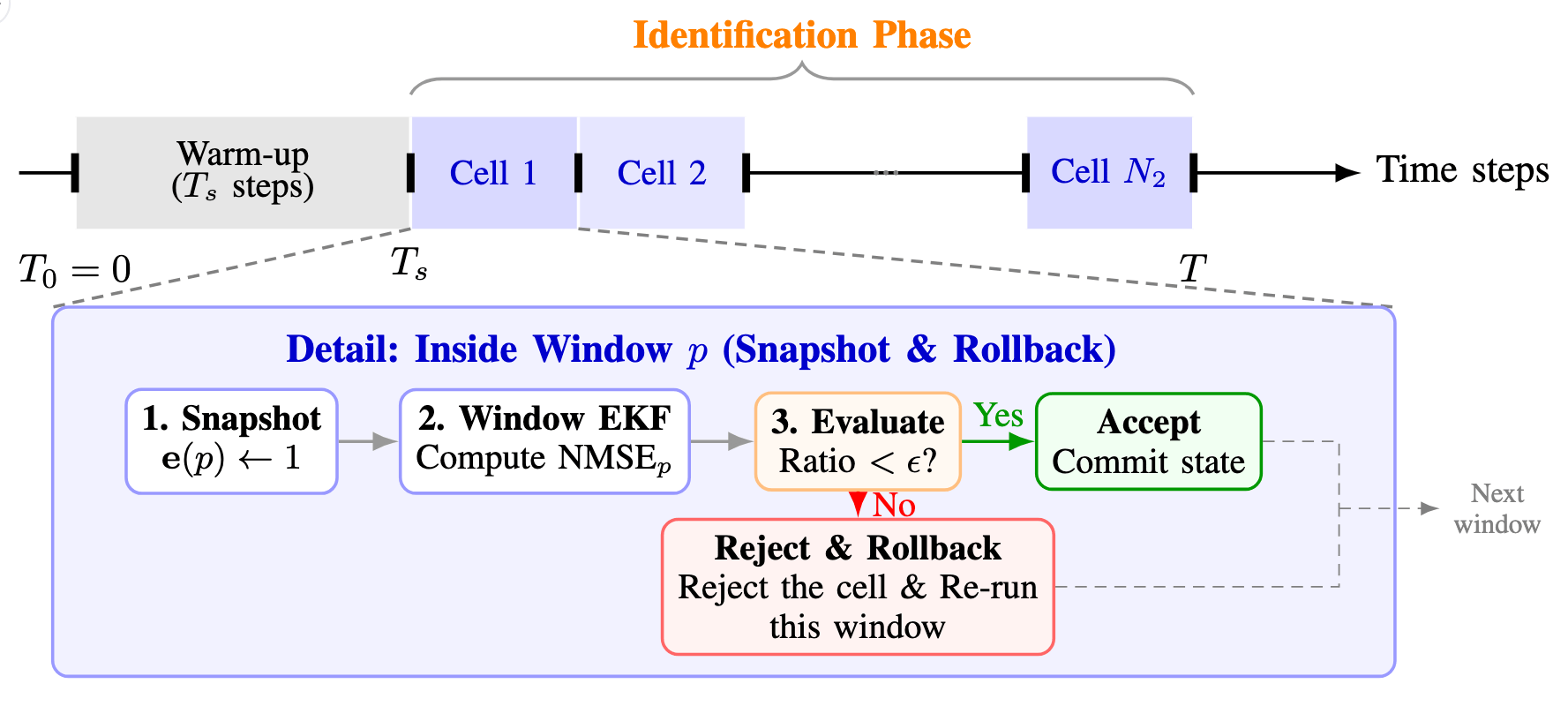
Online 2-cell identification algorithm. Following a T_s-step warm-up, candidate 2-cells are evaluated across N_2 discrete windows. In each window, the EKF state is first cached and a candidate 2-cell is activated. If the forecasting NMSE_p reduction meets the threshold the 2-cell is accepted. If rejected, the system executes a rollback to the cached state and re-runs the EKF using the original topology present at the start of the window.
Perhaps, the most fascinating challenge is what to do when the underlying shape of the network is incomplete. In many critical infrastructure networks, only lower-order topological structures—like nodes and edges—are actually known.
To solve this, we introduce a heuristic cell identification algorithm. This mechanism acts as a topological detective: it uses the learned process uncertainty as a proxy for missing higher-order constraints. If the topology lacks a required higher-order cell, the filter inflates localized edge uncertainties. The algorithm then sequentially activates candidate 2-cells (faces) and retains them if they successfully reduce the forecasting error, explicitly inferring the second-order cell structures directly from the data stream.
Does it work?
Validations on synthetic and real datasets from water, sensor, and transportation networks demonstrate that this approach yields reliable estimates under partial observability and successfully recovers the underlying topological structures. It consistently achieves the best forecasting performance because it explicitly models the underlying system dynamics, outperforming standard linear and purely graph-based models.
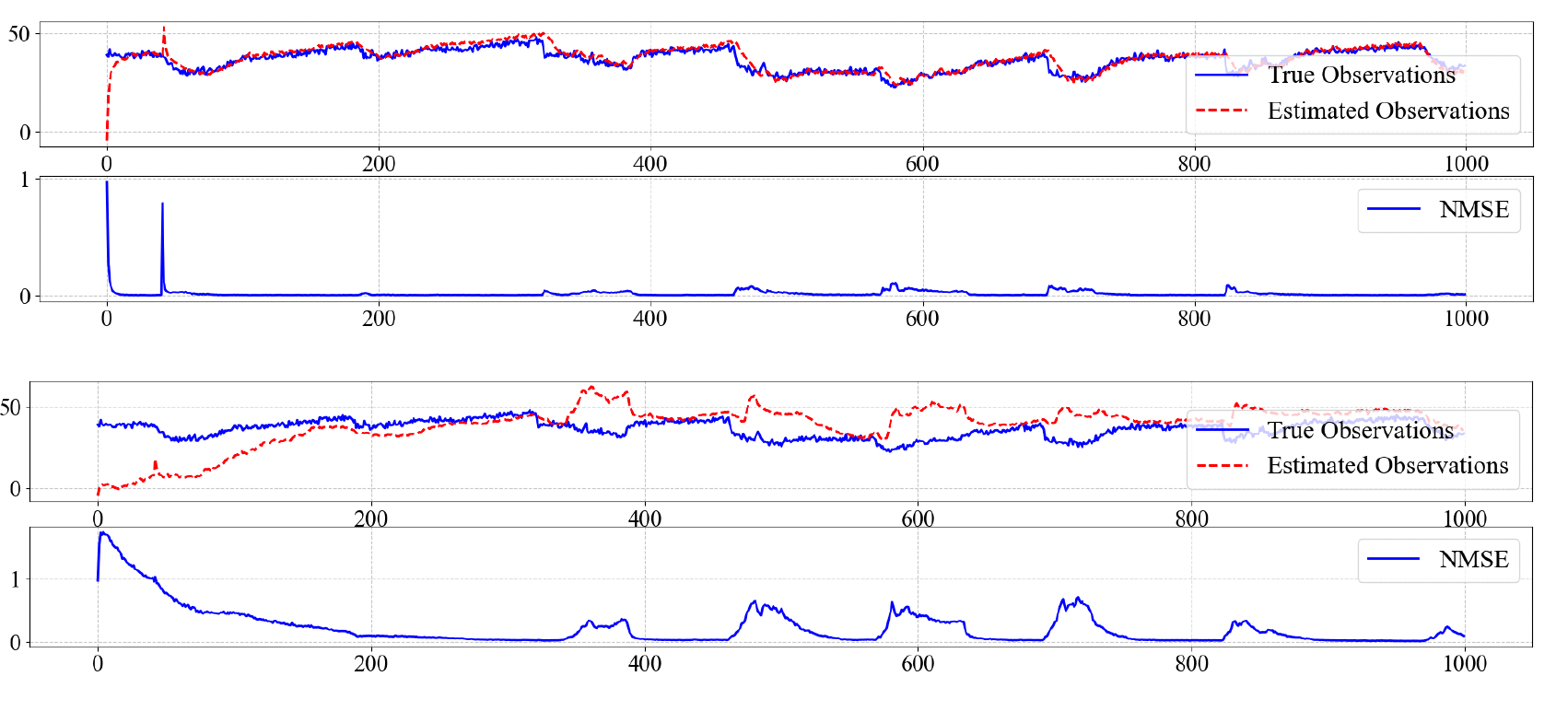
Forecasting comparison between complete and incomplete signals on a Wireless Sensor Network dataset. The top two subplots display the observation tracking performance and Normalized Mean Square Error (NMSE) with complete signal, while the bottom two subplots illustrate the same metrics for an incomplete signal containing 30% missing values. In the missing data case the observation tracking curves plotted is for an unobserved sensor. A notable feature in both scenarios is the appearance of periodic peaks in the forecasting error, which correspond to underlying distributional shifts in the data. Following each peak, the NMSE gradually converges to a lower value, demonstrating the model's ability to adapt to transient changes in the data distribution. Although this convergence is slower in the presence of missing data, the model successfully continues to track the true observations, showcasing its strong robustness.
Why this matters
Critical systems—epidemics, neural networks, power grids, transportation systems—are increasingly instrumented but still deeply under-sensed. We have a few measurements (confirmed cases, recorded neurons, grid sensors, traffic cameras), a lot of structure, and a lot of dynamics we need to understand in real time: to detect outbreaks early, predict seizures, anticipate blackouts, manage flow.
A topology-aware state-space model offers a principled way to combine all three: streaming data, physical structure, and uncertainty. It produces estimates not just of what we see, but of what we don't—and it can refine its picture of the network itself as new data arrives.
Open challenges
The framework addresses a real gap in state estimation: systems where observations are noisy and the underlying structure matters. In principle, this applies wherever network topology constrains signal flow—from infrastructure (water, power) to biology (neural circuits) to epidemiology (transmission). By treating the network's shape as a built-in constraint rather than an afterthought, we can track dynamics that graph-based methods miss. Yet the path to transformative impact opens several research frontiers:
- Continual learning on evolving networks. Extending online learning to detect and adapt when the topology itself changes—new circuits form, transmission routes emerge, infrastructure rewires. Scaling sparse inference.
- Joint topology and dynamics discovery. Building systems that simultaneously infer hidden structure and learn latent dynamics from streaming observations.
At SURE-AI, we are committed to advancing these methods precisely because they address this gap: principled, data-efficient inference for systems where trust and interpretability are non-negotiable. Our focus is on algorithms that are not just theoretically sound, but tractable and deployable on the infrastructure that keeps cities running, hospitals operating, and critical systems resilient.
Want to read the full paper? Topological Kalman Filtering on Cell Complexes lays out the full mathematical framwork, the observability anaysis, and detailed experiments on synthetic, water, sensor and bikeshare networks.
It's another step toward seeing signals not just as data in time or space, but as data with shape—and with dynamics that move along that shape.
Keep reading
Tracking the unseen: how topological Kalman filters reveal hidden network dynamics
May 2026
Research
Read more
Double-click to select video

Unifying Risk and Belief: A Foundation for Coherent AI Decision-Making
October 2025
Research
Read more
Double-click to select video
En annen sak med en tittel som dette
September 2025
News
Read more
The economics of overlapping generations: a stochastic lens
October 2025
Research
Read more
Toward trustworthy AI: recovering reliable decisions from corrupted and uncertain data
May 2026
Research
Read more

Risk-averse ensamble control: why "average" performance is no longer good enough
May 2026
Research
Read more
Double-click to select video

The Geometry of Data - Why Machine Learning Needs Signatures
February 2025
Research
Read more
Double-click to select video
SURE-AI kicks off: “of vital importance to our future”
December 2025
News
Read more

Beyond the Monolith: How Brain-Inspired AI is Building a More Reliable and Sustainable Future
November 2025
Research
Read more

Signals with shape: why topology matters for modern data?
November 2025
Research
Read more

Why horizon matters more than you think in decision making
November 2025
Research
Read more
Double-click to select video
The economics of overlapping generations: a stochastic lens
October 2025
Research
Read more
Double-click to select video
Unifying Risk and Belief: A Foundation for Coherent AI Decision-Making
October 2025
Research
Read more