

Toward trustworthy AI: recovering reliable decisions from corrupted and uncertain data
May 2026
Research
Read more
Risk-aware optimization in the age of uncertainty
- Toward reliable decision-making in AI, PDEs, and data-driven models
Uncertainty is everywhere in modern computational science. In machine learning, it appears as noisy training data or distribution shift. In engineering systems, it shows up through unknown loads, imperfect measurements, or modeling errors.
What is becoming increasingly clear is that the real challenge is not just uncertainty—but uncertainty about the uncertainty itself.
A recent paper by Harbir Antil, Alonso J. Bustos, Sean P. Carney, and Benjamín Venegas addresses this issue head-on. The authors develop a new framework for risk-averse optimization under distributional uncertainty, with a particular emphasis on systems governed by partial differential equations (PDEs).
From classical risk to modern AI challenges
In both optimization and machine learning, two ideas have become central:
- Risk-aware methods, which aim to guard against rare but catastrophic outcomes
- Robust methods, which aim to perform well even when the data distribution is misspecified
These ideas show up in different forms—CVaR in optimization, robust loss functions in deep learning, or distributionally robust training in modern AI.
However, there is a common difficulty: when data contains outliers, label noise, or adversarial perturbations, standard approaches often become either too conservative or unstable.
This is exactly the gap the present work tries to bridge.
Rather than committing to a purely worst-case viewpoint, the authors introduce a framework that balances caution with flexibility—something that is increasingly important in AI systems operating outside ideal training conditions.
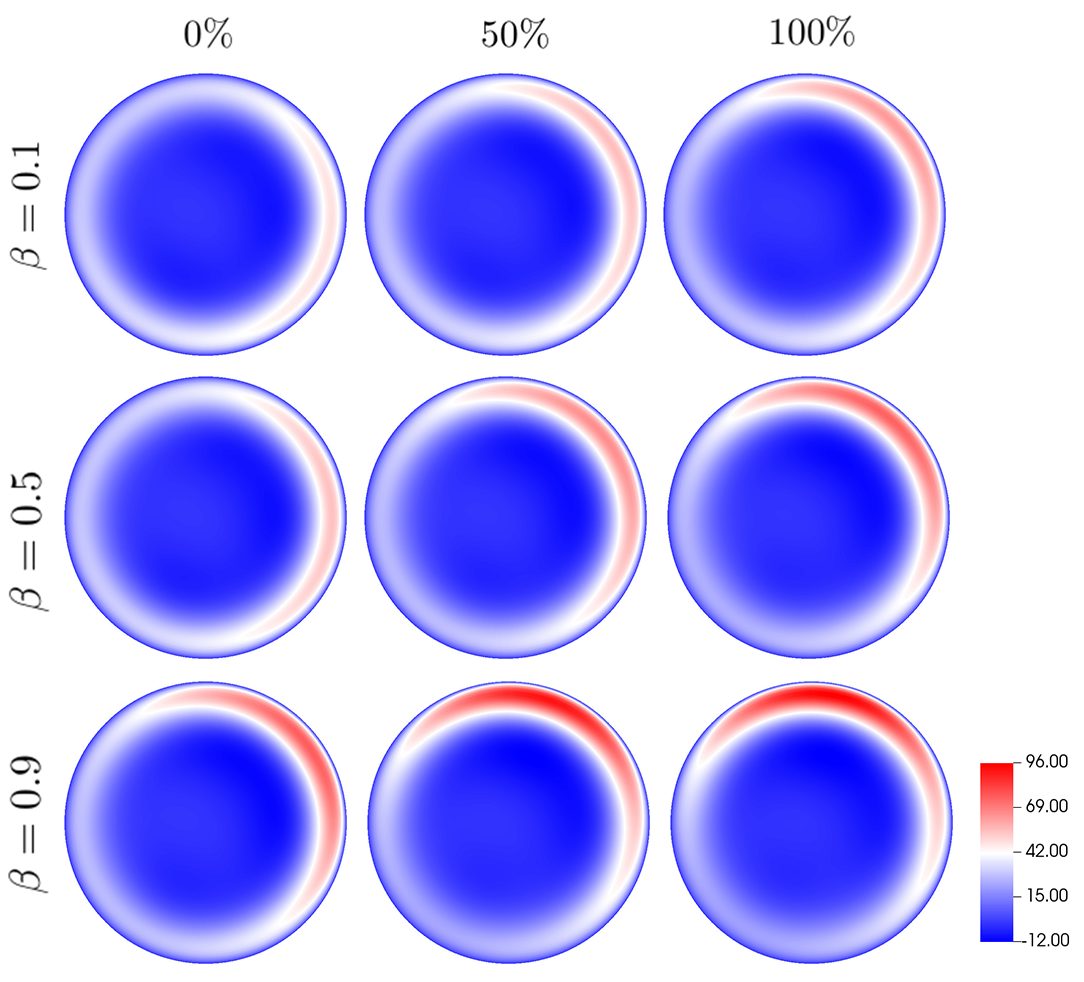
Optimal controls z ∗ for (6.7) (without any Rockafellian relaxation) for differing values of risk-tolerance β and corruption levels. All plots use the same legend.
Beyond finite-dimensional models
Another point where the work connects to AI is its treatment of high-dimensional structure.
Many modern learning systems—especially those involving physics or spatial data—operate in effectively infinite-dimensional settings (functions, fields, distributions). Yet most theoretical tools still rely on finite-dimensional approximations.
This paper avoids that limitation. The framework is built to handle infinite-dimensional probability spaces, which aligns naturally with:
- scientific machine learning
- neural PDE models
- digital twin systems
From a mathematical perspective, this requires careful analysis. The authors establish existence of solutions, derive optimality conditions, and prove convergence results in this general setting.
What happens in practice?
The numerical experiments are particularly revealing.
Even when the data is deliberately corrupted, the method is able to recover meaningful solutions. In some cases, it identifies what could be described as the “true” underlying solution—what one would expect if the data were clean.
From an ML perspective, this is closely related to:
- robustness to label noise
- recovery of latent structure
- resilience to distribution shift
What is notable is that this behavior is not heuristic—it emerges from the structure of the optimization problem itself.

Why this matters for AI
As AI systems move from controlled environments into real-world deployment, issues like data corruption, uncertainty, and reliability become central.
This work contributes to that discussion by offering:
- a principled way to handle uncertain and shifting distributions
- a framework that remains stable under outliers and corrupted samples
- a bridge between optimization theory and modern data-driven modeling
In that sense, it fits naturally within the broader vision of trustworthy AI—systems that are not only accurate, but also reliable under imperfect conditions.
Keep reading

Tracking the unseen: how topological Kalman filters reveal hidden network dynamics
May 2026
Research
Read more
Double-click to select video

Unifying Risk and Belief: A Foundation for Coherent AI Decision-Making
October 2025
Research
Read more
Double-click to select video
En annen sak med en tittel som dette
September 2025
News
Read more
The economics of overlapping generations: a stochastic lens
October 2025
Research
Read more
Toward trustworthy AI: recovering reliable decisions from corrupted and uncertain data
May 2026
Research
Read more

Risk-averse ensamble control: why "average" performance is no longer good enough
May 2026
Research
Read more
Double-click to select video

The Geometry of Data - Why Machine Learning Needs Signatures
February 2025
Research
Read more
Double-click to select video
SURE-AI kicks off: “of vital importance to our future”
December 2025
News
Read more

Beyond the Monolith: How Brain-Inspired AI is Building a More Reliable and Sustainable Future
November 2025
Research
Read more

Signals with shape: why topology matters for modern data?
November 2025
Research
Read more

Why horizon matters more than you think in decision making
November 2025
Research
Read more
Double-click to select video
The economics of overlapping generations: a stochastic lens
October 2025
Research
Read more
Double-click to select video
Unifying Risk and Belief: A Foundation for Coherent AI Decision-Making
October 2025
Research
Read more