Entanglement-induced feature-map designs for improving projected quantum kernel models
Quantum machine learning (QML) is a rapidly growing research direction, inspired by quantum mechanical principles such as superposition, entanglement, and interference. One such principle is entanglement, which essentially reflects how strongly correlated the information is shared through quantum bits (qubits).
(Huang, H. Y., Broughton, M., Mohseni, M., Babbush, R., Boixo, S., Neven, H., & McClean, J. R. (2021). Power of data in quantum machine learning. Nature communications, 12(1), 2631.)
What attracts the eye is the real challenge in applying and making a meaningful setup using entanglement-induced quantum kernel models. Projected quantum kernel (PQK) design was initially proposed by Huang et al. (2021) to handle the exponential dimensionality issue commonly found in standard quantum kernels.
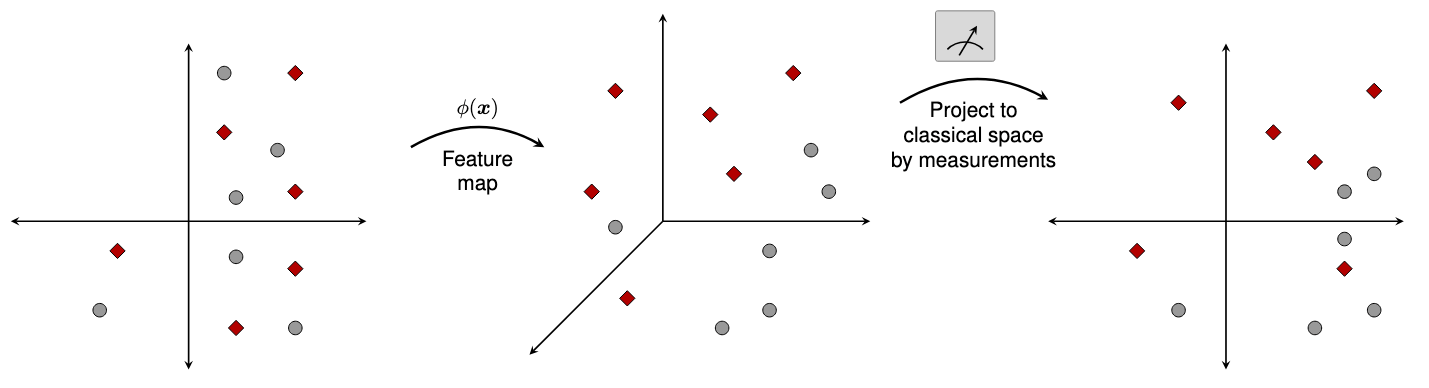
Figure 1: A schematic design of the PQK architecture, where the raw inputs are first mapped into quantum feature space using a quantum feature map ϕ, and finally projected back into a classical space through measurement
Formulation Process and Challenges
In PQK formulation, data is first encoded into quantum states using feature maps. Feature maps take quantum states to an exponentially higher dimension due to the nature of qubit scaling, then cleverly project them back into classical space using measurement strategies, before estimating the kernel values using the classical radial basis function (RBF) kernel.
A common challenge that has been found in such processes is how well one should design a feature map that simplifies the learning task. Moreover, this has been marked as a common issue in QML.
The other issue observed was over-tuning of the RBF and support vector machine (SVM) hyperparameters. We closely examine these practices as a key objective for future designing of quantum models in practice.
- Introducing entanglement-induced feature maps for useful PQKs, reducing hyperparameter sensitivity over untuned PQKs.
- Assessing extensive classical tunings on both PQKs and the RBF by isolating their native inductive biases.
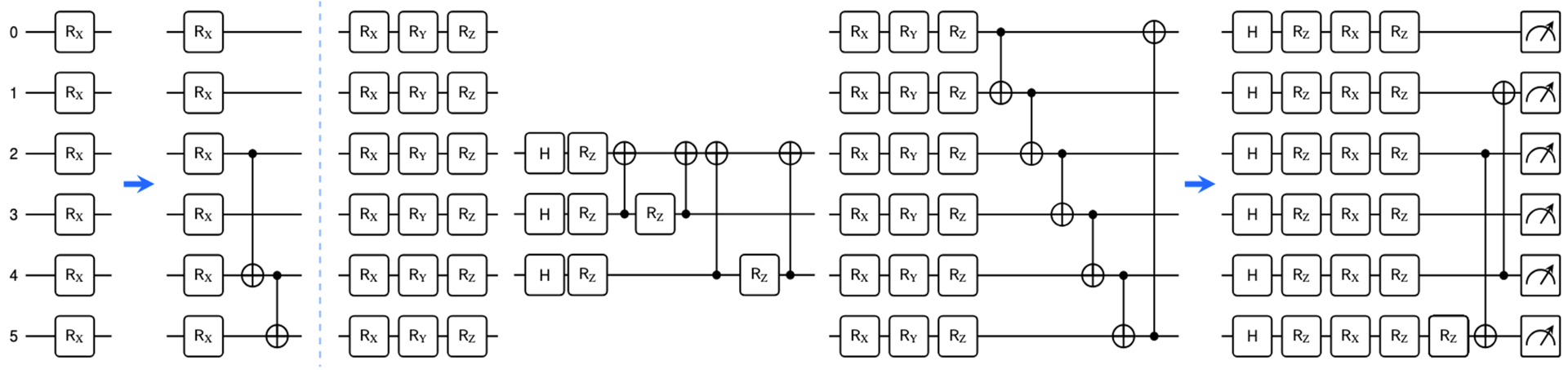
Figure 2: Schematic diagram of the distinct feature maps used for PQKs.
Standout Evaluation
The experiment evaluation based on industrial IoT data reveals an interesting phenomenon.
- Our proposed pairwise sparse entanglement strategies turned out to be superior in the classification task under a robust statistical setup.
- Our inductive bias analysis revealed that our feature map design was less sensitive than existing feature map designs and the RBF kernel.
What Future Holds
Our work touched on crucial aspects of QML in the growing field of quantum computing. The work offers the following.
- The entanglement process can be meaningful if applied carefully in QML.
- Future hybrid classical-quantum approaches should close the inductive-bias gaps to achieve true structural advantages.
Check out our work accepted for the 2026 IEEE 2nd International Conference on Quantum Artificial Intelligence (QAI), with early access available on arXiv: Can Entanglement-Induced Feature-Map Designs Improve Projected Quantum Kernels?.